
Night of the Living Dead Policies
Some HR policies just won’t stay buried. Unfortunately, employment law has moved on without them.
Somewhere in your business, there may be an employee handbook gathering dust. Nobody remembers who wrote it. Nobody knows when it was last updated. But every now and again, someone digs it out and insists, “That’s what our policy says.” The trouble is, the policy might have died years ago. Nobody told it. 🧟
WARNING: READ AT YOUR OWN RISK
This article contains outdated employment contracts, questionable HR practices and scenes of administrative neglect.
Reader discretion is advised. ⚰️
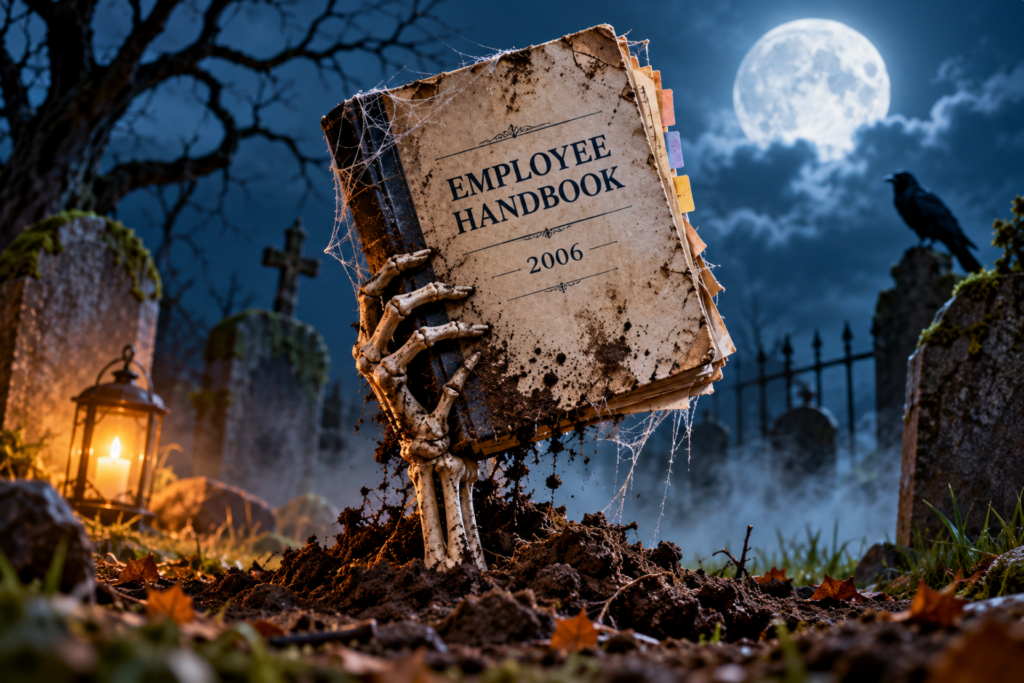
1. The Handbook That Time Forgot 📖
Nobody knows exactly how old it is. The previous office manager brought it with her from her last employer. Or perhaps it was the one before that.
It’s been copied, amended, printed, photocopied and occasionally used to prop up a wobbly desk.
It still refers to people who left the business in 2017, contains a maternity policy that predates the internet and tells employees to submit holiday requests on a form nobody has seen for years.
But it’s the employee handbook, so it must be right.
The frightening reality: An outdated handbook can create confusion about employees’ rights, managers’ responsibilities and the procedures the business is supposed to follow.
2. Night of the Living Dead Policies 🧟
Some policies simply refuse to die.
The sickness absence policy was written when you had five employees. Now you’ve got 35, and it really doesn’t work.
The disciplinary procedure refers to legislation that’s been replaced. And somewhere, lurking in the small print, is a grievance procedure requiring employees to write to a manager who retired six years ago.
Nobody deliberately decided to keep these policies. They just never got around to changing them.
And every time somebody asks, “Have we got a policy for that?”, out comes the same ancient document.
The frightening reality: Having a policy isn’t the same as having a legally compliant or workable policy. And if your managers follow an outdated procedure, you could find yourself defending decisions that should have been handled differently.
3. The Curse of Copy and Paste 📋
It seemed like a good idea at the time.
Someone found a free employment contract online, changed the company name and saved themselves a few hundred pounds.
Unfortunately, they forgot to remove the references to the previous employer, the Australian employment legislation and the entitlement to 25 days’ holiday plus 12 public holidays.
Ten years later, everybody is still using it.
The frightening reality: Employment contracts aren’t just paperwork. They establish important contractual rights and obligations. Poorly drafted or contradictory terms can become expensive when something goes wrong.
4. The Phantom HR Department 👻
Everyone thinks somebody else is looking after HR.
The accountant deals with payroll. The office manager keeps the holiday spreadsheet. The supervisor handles sickness absence. And the MD gets involved when somebody threatens to resign.
It’s a system that’s worked perfectly well for years.
Until somebody asks who is responsible for updating the employment contracts, checking the handbook or making sure managers understand the procedures.
Silence.
A distant door creaks.
The frightening reality: HR responsibilities don’t disappear because nobody has been formally allocated them. Small employers still need clear processes, accurate documentation and somebody taking responsibility for keeping things up to date.
5. The Skeletons in the Filing Cabinet 💀
Every business has that cupboard.
The one containing unsigned contracts, old disciplinary letters, holiday forms, training certificates and a mysterious folder labelled ‘Personnel – Miscellaneous’.
Nobody dares throw anything away, just in case.
Nobody quite knows what’s in there either.
And when an employee makes a subject access request, the entire contents suddenly become rather more interesting.
The frightening reality: Keeping everything forever isn’t necessarily safer than throwing everything away. Employers need appropriate retention periods, secure records and a sensible approach to personal data.
Time for a Little Grave Robbing?
You don’t need to dig up every HR document and rewrite it overnight.
But you should know what’s lurking in your business.
When was your employee handbook last reviewed? Do your employment contracts reflect how people actually work? Are your managers following procedures that are still appropriate?
And perhaps most importantly, who is responsible for making sure they stay that way?
Because the really frightening thing about outdated HR paperwork isn’t how old it is.
It’s discovering what it says when you actually need to rely on it.
Not sure whether your employee handbook is alive, dead or somewhere in between?
Kea HR can help you find out: no exorcism required. 👻
Kea HR does not advocate actual grave robbing. Digging up ancient employment contracts, however, is positively encouraged.
Practical HR Advice, Straight to Your Inbox
Employment law updates, useful HR guidance and practical tips for managing people in small businesses.
Join the Kea Mailing List →


